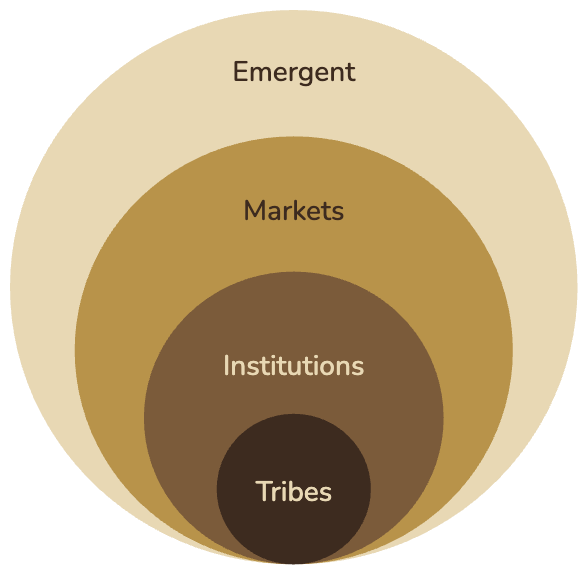
Human societies have produced four broad forms of coordination over the past five thousand years. Each emerged in sequence and each solved problems the prior forms couldn’t solve. Each externalized costs onto the substrate the next form would have to organize. All four now operate simultaneously in every geography on earth. TIME is the framework that helps us explore each form: Tribes, Institutions, Markets, Emergent.
 |
|---|
| It’s about TIME, the evolution of human coordination |
The origin
TIME builds on the TIMN Framework developed by RAND analyst David Ronfeldt, first set out in his 1996 paper Tribes, Institutions, Markets, Networks: A Framework About Societal Evolution (RAND P-7967) and developed further in his 2025 Substack series Rethinking What ‘Tribes’ and ‘Networks’ Are Good For. Ronfeldt argues that each form gained strength at a different rate and matured in a different historical epoch, that each rests on its predecessors, and that each is tied to a distinct information and communications revolution.
TIME retains Ronfeldt’s first three forms and renames his fourth. Where Ronfeldt writes Networks (+N), TIME writes Emergent (+E). The renaming reflects a practical reality: the word “network” has been stretched to cover everything from Roman trade routes to social media platforms, and its meaning has thinned to the point of unusability in a coordination context. Emergent names what the fourth form actually does. The analytical framework is unchanged, and the vocabulary is sharpened. While it may be too early, this wiki makes the claim that the Emergent is the BioConomy. A healthy and high-functioning society has good representation of all four forms.
The four forms
T: Tribes
Kinship, identity, belonging. Coordination through shared story, loyalty, and reciprocal obligation. The organizing logic is loyalty. This is the oldest coordination form, and it still runs underneath everything else. A sports team’s fanbase, a diaspora community, a family gathering at a funeral: each operates through T-form coordination. The characteristic physical expression of the T form is the sacred site, the place where, in Mircea Eliade’s terms, the sacred breaks into profane space and consecrates a fixed point around which community life organizes. See T form (Tribal) for the glossary entry.
I: Institutions
Hierarchy, rules, and command structures. Coordination through formalized authority, codified rules, and vertical accountability. The organizing logic is legitimacy. Institutions built roads, schools, courts, water infrastructure, and the administrative apparatus that underpins collective life at scale. The characteristic physical expression of the I form is the cathedral, the palace, the capitol: structures that compress hierarchical authority into visible, awe-producing form. When an institution functions well, it holds a community’s shared infrastructure in trust. When it fails, the infrastructure collapses with it, and the communities it served are left to coordinate through whatever other forms remain available to them. See I form (Institutional).
M: Markets
Prices, exchange, and competition. Coordination through decentralized transactions between self-interested actors. The organizing logic is efficiency. Markets organized industrial civilization and remain the dominant coordination form in the global economy. The characteristic physical expression of the M form is the skyscraper and the trading floor, with the stock index as its legibility signal: a single number compressing the activity of thousands of firms into a figure that can be read at a glance. Markets solved the coordination problems that hierarchical institutions could not solve at the scale industrial production demanded. They externalized costs onto labor, onto communities, and onto the biosphere. See M form (Market).
E: Emergent
The fourth form, currently arriving. Coordination through pooled commitments toward outcomes no single actor can produce alone. The organizing logic is reciprocity at the scale of the watershed, the catchment, the bioregion. The Emergent form does not replace the previous three. It holds them inside a frame that can account for the costs they externalized. The characteristic physical expression of the E form is the bioregional hub: a place-anchored coordination point that organizes activity around a defined living system. Its legibility signal is still forming. The Guardians of Earth BioScore is one candidate, a composite index that compresses biodiversity, community engagement, and restoration evidence into a single number. Whether this signal matures or something else takes its place is an open question. The E form is genuinely emergent, and honest assessment requires acknowledging that it has not yet produced the equivalent of the cathedral, the skyscraper, or the stock index. See E form (Emergent).
Network topology vs. Emergent coordination
A recurring confusion is worth naming here, because it can undo the whole framework if it is not held straight. The word “network” carries two distinct meanings, and TIME uses only one of them.
Network as topology (nodes and edges, connective tissue, the graph structure that links parts of a system) has always been present under every coordination form. Trade routes, kinship webs, monastic correspondence circles, merchant houses, the Silk Road: each is a network in the topological sense, and each is older than the fourth coordination form the framework names. Network topology is not itself a coordination form. It runs through T, I, M, and E as connective tissue, the way blood vessels run through every organ regardless of the organ’s function.
Emergent as coordination logic (pooled commitments toward outcomes no single actor can produce alone, at the scale of the watershed or bioregion) is genuinely new. The topology was ancient long before the digital era. What arrived with the digital era was the ability to coordinate at planetary scale through pooled forward commitments, verified against measurable outcomes, without either state authority or market price. That is what E names.
The distinction matters when people import TIMN into TIME assuming the fourth form is “networks in the digital age.” It is not. Ronfeldt’s original N conflated the two senses, which is part of why he himself has been rethinking the framework in his 2025 Substack series. TIME separates them: network topology runs everywhere as connective tissue; Emergent coordination is a specific and genuinely new logic, currently arriving.
The sequence and the debt
Each coordination form produces a characteristic physical node where its logic materializes. The sequence clarifies what the E form inherits.
The Farm is the first coordination node (approximately 12,000 years ago). A community settling in a particular place, holding kin, land, water, and labor. Collectively producing surplus for the first time. Optimization target: caloric yield per unit of land. Externalized cost: soil depletion, downstream water quality, and the commons the farm was carved from.
The Stock Market is the second (approximately 250 years ago). Ownership decoupled from operation. The farmer no longer has a direct relationship with those consuming what he produces. His crop goes to a distant processing plant, and his role is replaced by the shareholder who owns a claim on an enterprise the shareholder will never enter. Optimization target: return on capital. Externalized cost: labor conditions, biosphere depletion, and the coherence of the communities from which labor is drawn.
The Data Center is the third (approximately 50 years ago). Coordination of attention, behavior, information, and computation. Optimization target: prediction accuracy, which is human coordination at global scale. Externalized cost: energy and water, consumed at rates that break local hydrological budgets and strain electricity grids.
The BioHub is the fourth, currently emerging. A place-anchored coordination point that organizes activity around a defined watershed or bioregion. Three features distinguish a BioHub from a farm, an ecovillage, or a conservation project: a physical site that anchors regeneration beyond its own boundaries, an outward orientation toward the bioregion, and a role as connector across multiple domains of activity. Optimization target: the continued viability of the substrate it depends on. Externalized cost: there is no substrate below it to receive the costs.
That last observation is the critical one. Each era’s externalities became the next era’s inheritance. The BioHub is where the running debt comes due, because there is nowhere left to push it. The debt that must now be repaid is what creates economic value for communities that can coordinate at this level. Rural communities hold a natural monopoly on what the Market and the State now need: functioning watersheds, biological complexity, soil carbon capacity, and the coordination infrastructure to maintain them. The BioHub is the node through which that monopoly becomes coordinated.
What TIME is and what it is not
TIME is an analytical vocabulary. It gives practitioners a way to see which coordination forms are active in their bioregion, which are absent, which are in conflict, and where the seams between forms are producing friction that no single form can resolve on its own.
TIME is not a developmental ladder. The four forms are not stages that a community passes through and leaves behind. They are layers that accumulate. A functioning bioregion operates through all four simultaneously. A community that has strong T-form bonds (identity, loyalty, mutual obligation), strong I-form infrastructure (governance, law, administration), healthy M-form exchange (local markets, cooperatives, trade), and emerging E-form coordination (commitment pooling, watershed-scale reciprocity) is more resilient than one that has developed the later forms at the expense of the earlier ones.
The shift TIME asks of its users is perceptual before it is operational. A practitioner who sees only through the Market lens will optimize for revenue. One who can also see through the Tribal lens will recognize belonging. Through the Institutional lens, governance. Through the Emergent lens, the pooled commitments that make the entire ecosystem productive. The BioHub Diagnostic (available elsewhere on this site) surfaces which lens a person or organization is currently seeing through, so that the lenses they are not yet using become nameable.
Related pages
- The TIMN Framework
- The Evolution of Coordination Nodes
- Commitment Pooling
- David Ronfeldt
- T form (Tribal)
- I form (Institutional)
- M form (Market)
- E form (Emergent)
Sources
- Ronfeldt, D. (1996). Tribes, Institutions, Markets, Networks (RAND P-7967)
- Eliade, M. (1957). The Sacred and the Profane
Provenance
Extracted from The TIME Framework (Notion export, September 2026). Voice preserved; em dashes replaced. Internal cross-references to the Evolution of Coordination Nodes page and to the glossary entries for each of the four forms were made explicit here.