Welcome!
You’re in the right place to explore the emerging, parallel BioConomy.
What’s the Difference Between the Economy and the BioConomy?
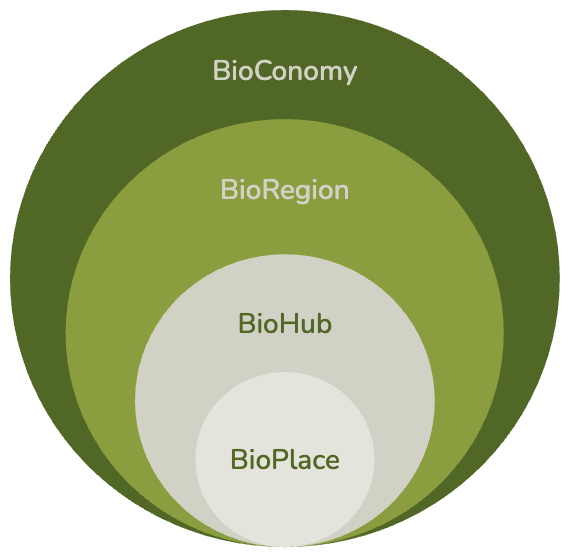
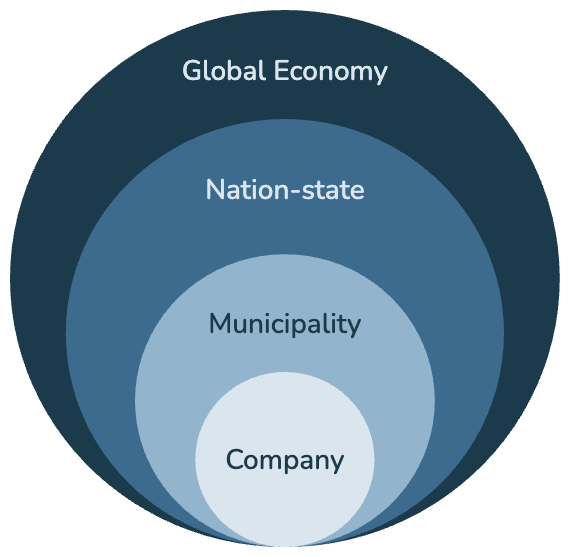
| The BioConomy is determined by ecology: watershed, soil type, and the culture found within the living system of place. | The conventional economy’s nesting is set by administrative boundaries and ownership. Tabled here for easy comparison. |
|---|
 |  |
|---|
In a highly functioning society, both BioConomy and Economy operate in parallel. The Economy coordinates the mechanical factory, and the BioConomy coordinates the ecological factory.
| Emergent | Familiar |
|---|---|
| Tap on or hover over any term for an explanation of how each nested layer supports the BioConomy: | Hover over any term to explore the key differences between BioConomy and Economy: |
| BioConomy | Global Economy |
| BioRegion | Nation-state |
| BioHub | Municipality |
| BioPlace | Company |
| Ecological Factory | Mechanical Factory |
Why Now?
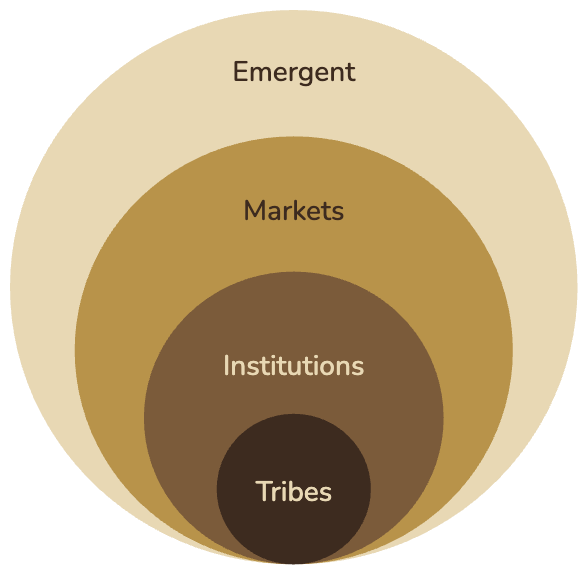
The way society has organized itself has evolved over time through four distinct forms. In a highly functioning society, all four forms are represented, in balance:
 |
|---|
| The Evolution of Human Coordination |
Tap on or hover over each form for an explanation:
-
In the Economy, under the dominant Market form, people relate to Institutions and Markets as clients: taxes and wages buy services and consumption.
-
In the BioConomy, under the Emergent form, people relate to those same Institutions and Markets as providers, supplying the outcomes those Institutions and Markets need and cannot produce internally.
This wiki exists to provide everything required to operate effectively in the BioConomy.
To learn how to use the wiki, visit Three ways to engage with the wiki.
Provenance
Created 07 September 2026 as a simplified diagramatic wiki landing page. Updated 8 September 2026 to balance character count in the Difference table so that images are approximately equal.